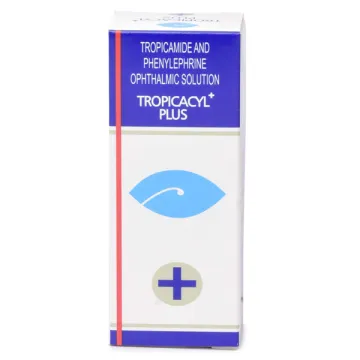
Tropicacyl Plus 3 ml
Product highlights
Description
Tropicacyl Plus Eye Drops is a sterile ophthalmic solution available in a 5 ml bottle. Each ml of the solution contains Tropicamide 0.8% w/v and Phenylephrine Hydrochloride 5% w/v as the active ingredients, along with Chlorbutol 0.5% as a preservative and aqueous base q.s. The product is strictly for external ophthalmic use only and must not be injected or ingested. It is a combination mydriatic and cycloplegic agent used primarily in ophthalmic diagnostic procedures and certain therapeutic conditions.
Tropicamide is a muscarinic receptor antagonist (anticholinergic) that blocks the action of acetylcholine at muscarinic receptors in the eye. By inhibiting the sphincter pupillae muscle (the circular muscle of the iris) and the ciliary muscle, it causes relaxation of these muscles, leading to pupil dilation (mydriasis) and temporary paralysis of accommodation (cycloplegia). Phenylephrine Hydrochloride is a synthetic sympathomimetic agent and an alpha-1 adrenergic agonist that acts on the dilator muscle of the iris, causing it to contract and further widen the pupil. Together, these two agents work synergistically to produce a more effective and sustained mydriatic effect than either drug alone, allowing thorough examination of the interior structures of the eye including the retina, optic disc, and blood vessels.
The primary indications for Tropicacyl Plus Eye Drops are the dilation of the pupil (mydriasis) for diagnostic eye examinations and the relaxation of the ciliary muscle (cycloplegia) for diagnostic procedures. It is used in ophthalmoscopy (retinal examination) to visualize the fundus, in the detection and management of eye inflammation such as uveitis, and during pre-operative and post-operative eye procedures. For therapeutic purposes in uveitis, it helps reduce pain and spasm of the ciliary muscle while preventing the formation of posterior synechiae (adhesions between the iris and lens). The product is typically administered as a single application right before the eye examination or procedure and is not intended for regular daily use unless directed by an ophthalmologist for therapeutic purposes.
The recommended dosage for diagnostic and pre-operative purposes is 1 to 2 drops instilled into the affected eye(s) 15 to 30 minutes prior to the procedure. For therapeutic purposes such as uveitis, the dosage is 1 to 2 drops two to four times daily or as required by the ophthalmologist. The mydriatic effect typically begins within 10 to 20 minutes after instillation and lasts for approximately 4 to 6 hours, though some sources indicate the effect may last up to 24 hours. Cycloplegia (paralysis of accommodation) lasts for a shorter duration, typically 2 to 3 hours. Patients should not use more drops than directed, and the product should only be used under the supervision of a qualified ophthalmologist.
The most common side effects include mild stinging or burning sensation in the eye immediately after application, temporary blurred vision, increased sensitivity to bright light (photophobia), and dry mouth or throat. Other common side effects include eye pain, eye irritation, ocular hyperemia (redness), conjunctivitis, headache, dizziness, and nausea. These effects are generally mild and transient, resolving within a few hours as the drug wears off. Uncommon side effects may include skin rash, hypotension (low blood pressure), tachycardia (rapid heartbeat), increased intraocular pressure, constipation, urinary retention, and drowsiness.
Serious but rare side effects include severe allergic reactions (rash, swelling of face/lips/tongue, difficulty breathing), nervous system effects in children (confusion, behavior changes, disorientation, hyperactivity, restlessness, hallucinations, seizures), and significantly increased intraocular pressure that could harm vision or worsen glaucoma. Patients should seek immediate medical attention if they experience severe eye pain, sudden vision loss, rapid or irregular heartbeat, chest pain, fainting, or signs of a severe allergic reaction.
Important precautions include removing contact lenses at least 15 minutes before instilling the drops and waiting until the mydriatic effect has worn off before reinserting them. The product is contraindicated in patients with narrow-angle glaucoma or narrow angles, as it may precipitate an acute angle-closure crisis. It should be used with caution in patients with cardiovascular disease, hypertension, hyperthyroidism, or those who have recently taken MAO inhibitors (within 21 days), as exaggerated adrenergic effects may result. Patients should avoid driving or operating heavy machinery until their vision returns to normal, as blurred vision and photophobia are expected. Wearing protective sunglasses after use is advisable to protect from bright light. The product is not recommended for use in patients below 18 years of age without medical supervision.
The product should be stored in a cool and dry place away from direct sunlight and kept out of reach of children. The dropper tip should not be touched to any surface to maintain sterility. The product is available in India at a price range of approximately 65 to 85 rupees per 5 ml bottle and is available through major online pharmacy platforms and offline pharmacies with a valid prescription.
Key benefits
Directions for use
Use as directed on the product label, or as advised by your healthcare provider.
Safety information
Chat with us
Product details
| Brand | Eye Care |
|---|---|
| Manufacturer | QuickCure Distribution LLC |
| Country of Origin | USA |
| Expiry Date | Best before 24 months from manufacture |